The Sword of Kaigen captures the clash between progress and tradition while examining the personal anguish surrounding existence in a society defined by misogyny. It is an imperfect book in some respects, but at its best its thrilling and exciting while detailing an engrossing fantasy world. The setting is best described as Japanese military fantasy, with battles between warriors who are masters in elemental magic and deadly sword fighting.
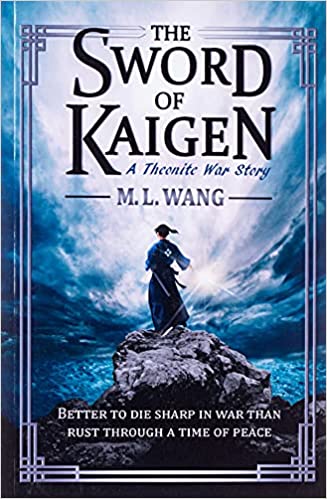
The story swirls around Misaki Matsuda, the matriarch of the Matsuda clan, the ancient protectors of Kaigen. Her husband is a cold man, engrossed in his own thoughts to the point where he seems alien, even to his wife. Her son Mamoru, the heir to his father’s legacy, straddles the divide between his parents, striving to live up to his father’s reputation while, at times, seeing the world through his mother’s eyes. The plot is at times grim – very grim, in fact – and descends into some extraordinarily bleak places, but there are plenty of excellent moments when the painstakingly defined characters swing into action.
There are some perplexing parts to the book which made it a bit of a difficult read. The start is quite slow, which allows the reader to soak in the lives of the main cast, but it drags on quite a bit with perhaps too much density before the story really starts to gain pace. Likewise, there are some flashbacks which act as windows into another world and another life, but the worldbuilding in those alternate scenarios seems thin to the careful attention paid to life on the mountain where the main narrative is set. Some of those scenes really feel a bit out of place when the tone of the main story is considered.
Besides the slow start, the book seemingly climaxes in a real way reasonably early and the reader is left with a slow burn to finish, mirroring the early chapters of the book. Those scenes are important and emotive, perhaps they could even be considered to be the real heart and soul of the book, but I couldn’t help but feel that the meandering of the start and finish defined the story rather than the pulsating action of the middle portion.
But having said that, the book really is a good read. The examination of a clash of cultures, tradition vs innovation, progression vs stability, illustrated by some powerfully emotional scenes and wonderful action sequences make the Sword of Kaigen a very worthwhile read. The lack of focus at times is a minor complaint in the scheme of things.
 PJ Wilson Books